How the Reggio Emilia Approach Enhances Your Child’s Learning
Topics: Child Development
Age Range: Preschool
The Reggio Emilia approach is a flexible, hands-on, child-centered philosophy where children are encouraged to express themselves, explore their interests, and develop their personalities through a self-guided curriculum. It rests on the belief that children are capable, curious, and active participants in their own learning rather than passive recipients of information. Like any Miami Shores preschool curriculum, it has both strengths and limitations, but there’s a reason it has been practiced and admired for more than 70 years.
In this article, we’ll break down how the Reggio Emilia approach enhances your child’s learning and why it continues to influence early childhood education around the world.
1. It enhances critical thinking through inquiry and exploration
One of the most impactful ways the Reggio Emilia approach enhances learning is by promoting critical thinking and problem-solving skills. Instead of relying on worksheets or rigid lesson plans, children engage in open-ended exploration based on their interests. According to a study published in the peer-reviewed journal Early Childhood Education Quarterly, Reggio-inspired environments use a participatory learning methodology that helps young children develop innovative thinking through research, experimentation, and inquiry. This means children aren’t memorizing facts; they’re generating questions, hypothesizing, testing ideas, and reflecting on results. These foundational thinking skills transfer to every subject they encounter later in school and life.
2. It enriches language and social skills through collaboration
Learning in a Reggio Emilia classroom isn’t isolated; it’s social. Collaboration is built into every interaction, and this matters for early learners. Research from the National Association for the Education of Young Children (NAEYC) shows that when children work together to solve problems, negotiate shared meaning, and express their ideas, they simultaneously strengthen language, social, and cognitive development. Reggio classrooms encourage group work, shared projects, and extended dialogue among peers and adults. Young students practice communicating clearly, listening to others, and refining ideas. They also learn to see language as a tool for thinking, not just compliance.
3. It strengthens engagement through the “Environment as the Third Teacher”
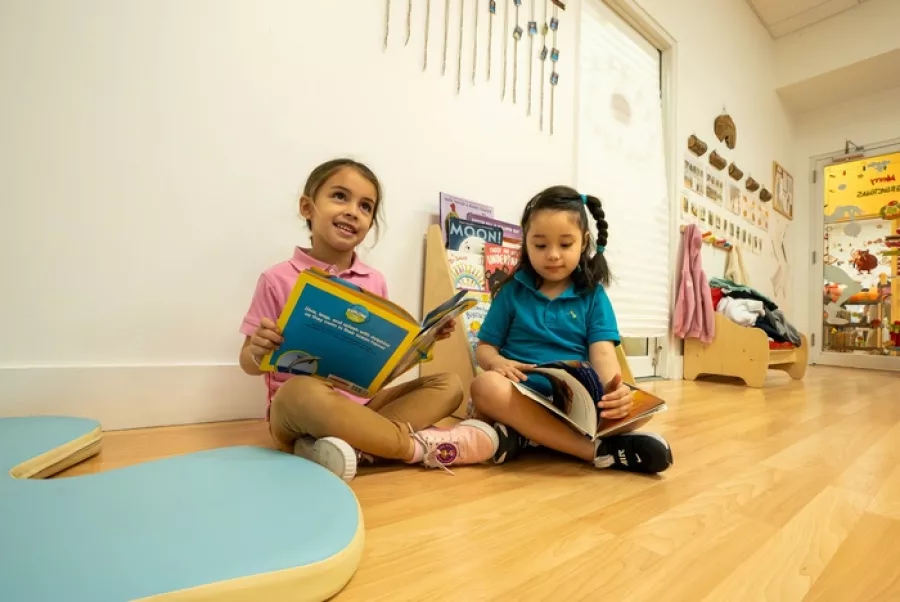
A core principle of the Reggio Emilia approach is that the environment itself enhances learning. In this model, the classroom is intentionally designed to provoke curiosity, inspire exploration, and invite interaction. Educators often refer to this concept as the “third teacher.” Research highlighted by the Reggio Children organization in Italy emphasizes that when spaces are open, light-filled, and equipped with materials that invite manipulation and discovery, children show higher engagement and initiative. When young learners at a Miami Shores preschool feel respected and stimulated by their surroundings, they’re more likely to take risks, ask questions, and immerse themselves in sustained exploration.
4. It supports creative expression through multiple “languages” of learning
Another way the Reggio Emilia approach enhances learning is by recognizing that children express understanding in many forms, not just through words. This principle, often called the “hundred languages of children,” values art, movement, storytelling, dramatic play, and building as legitimate ways to think and communicate. Child development researchers who study Reggio Emilia methods emphasize that honoring diverse modes of expression strengthens confidence, supports emotional development, and helps children articulate complex ideas long before they are ready for formal written expression.
5. It promotes family and community involvement
Reggio Emilia doesn’t treat learning as something that happens only at school; it actively involves families and community members as co-learners and partners. Strong family engagement enhances communication skills and reinforces learning beyond the classroom. When parents and teachers collaborate around a child’s interests and projects, children experience continuity in learning that supports deeper understanding and stronger relationships. This partnership strengthens trust and boosts motivation.
Because the Reggio Emilia approach places the child’s interests at the center, learning becomes meaningful rather than mechanical. This educational approach enhances a child’s learning by making education active, social, expressive, and deeply engaging. It nurtures thinking, communication, creativity, and confidence not just for school, but for life. If this sounds like the kind of educational environment you are looking for your child, contact our Miami Shores preschool today.