Reggio Emilia Vs Montessori: Choosing The Best For Your Child
Topics: School Life
Age Range: Preschool
Parents often compare the Reggio Emilia approach vs Montessori approach when seeking a nurturing, research-informed start to education. Both philosophies view children as capable, curious learners with unlimited potential, yet they differ in how learning unfolds day to day, the role of the teacher, and the way the classroom environment is used to inspire discovery.
Understanding these distinctions can help families make confident choices about the educational path that best aligns with their child’s personality, interests, and long-term growth. Below is a clear, expanded guide to highlight the strengths of each approach and support you in deciding what fits your child and family best.
Origins & Core Philosophy for Reggio Emilia and Montessori
Reggio Emilia philosophy
Emerging in Reggio Emilia, Italy, after WWII under Loris Malaguzzi, this philosophy views children as strong, curious, and full of potential. Learning is social and co-constructed through relationships with peers, teachers, families, materials, and the broader community. The approach is intentionally non‑prescriptive; it adapts to context and evolves through collaborative reflection. Creativity is considered a way of thinking, not a subject. This adaptability ensures that each child's unique learning journey is respected and nurtured.
Montessori philosophy
Developed earlier by Dr. Maria Montessori, Montessori is a method with a globally recognized set of principles. It emphasizes independence, concentration, and self‑discipline in a carefully prepared environment. Materials are sequenced from concrete to abstract and are designed with "control of error" so children can self‑correct. This structured approach provides a clear roadmap for a child's learning progress, giving parents a sense of security about their child's educational journey.
In short, when comparing the Reggio Emilia philosophy vs Montessori philosophy, the key difference lies in flexibility and authorship of learning. Reggio Emilia emphasizes emergent, collaborative inquiry shaped by children’s interests, while Montessori emphasizes self-paced mastery guided by a carefully prepared sequence of materials and lessons.
If you're also weighing other approaches, our guide on the difference between Waldorf and Reggio Emilia can help you compare across all three philosophies.
How Learning Unfolds Day to Day
Reggio Emilia
Learning emerges from children’s questions and interests, typically through longer‑term projects (inquiry into light and shadow, neighborhoods, insects, water). Teachers provoke thinking with open prompts, document the journey, and help children revisit ideas. The curriculum is not pre‑written; it is co‑authored.
Montessori
Learning flows through self‑chosen work cycles. Children select activities from shelves of didactic materials (practical life, sensorial, language, math, culture). Lessons are offered individually or in small groups, and the child practices until mastery.
The difference between Reggio Emilia and Montessori in this area is clear: Reggio emphasizes collaborative exploration and revisiting ideas together. In contrast, Montessori emphasizes focused individual work and steady progress through learning materials.
The Environment (The “Third Teacher” vs The “Prepared Environment”)
Reggio Emilia
Classrooms are atelier-like, with natural light, mirrors, plants, fundamental tools, and displays of children’s thinking. Spaces change with projects: a corner may become a studio, a mapping station, or a mini‑lab. Walls display documentation (photos, quotes, sketches) to make learning visible.
Montessori
Rooms are calm, ordered, and consistent, with child‑sized furniture and a familiar layout. Materials live on low shelves so children can independently select, use, and return them. The aesthetic tends toward simplicity to reduce distraction and support focus.
Both classroom environments are thoughtfully designed, but in the comparison of Reggio Emilia vs Montessori, Reggio spaces shift and adapt to children’s ongoing inquiries. In contrast, Montessori spaces remain consistent and orderly to support focused, independent work.
Role of the Teacher
Reggio Emilia
Teachers act as co‑researchers and collaborators. They pose provocations, join investigations, and study children’s strategies. Documentation drives planning; educators meet to analyze artifacts and decide next steps.
Montessori
Teachers serve as guides. They observe readiness, give precise lessons, and then step back so the child can concentrate. Intervention is minimal and timed so as not to interrupt deep work.
Reggio places its focus on shared meaning-making, where children and teachers build knowledge together. At the same time, Montessori emphasizes individual self-construction, allowing each child to grow through independent exploration and mastery.
Materials: “Hundred Languages” vs Didactic Materials
Reggio Emilia
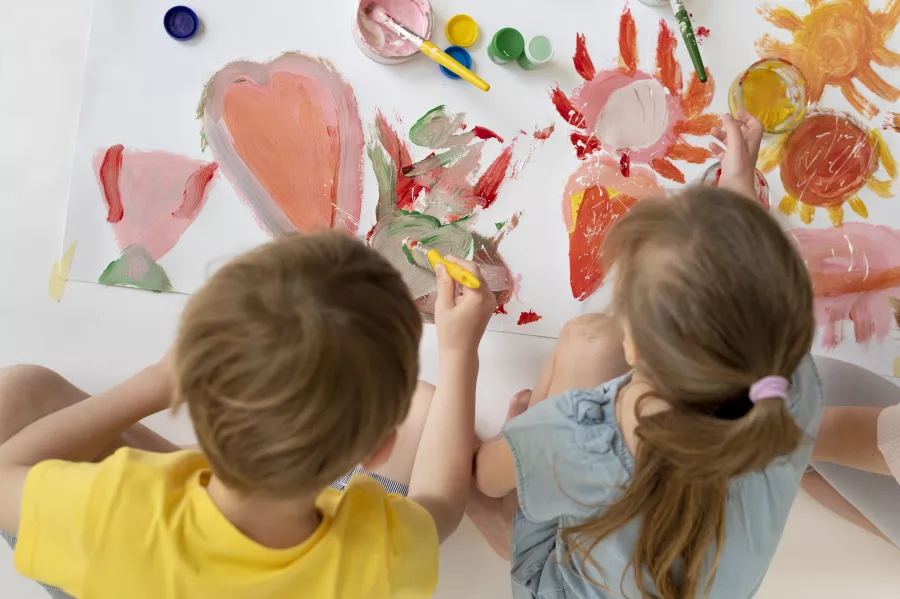
In the Reggio Emilia approach, materials are seen as open-ended and expressive. Clay, fabric, wire, wood, light, and digital tools become languages through which children think and communicate. This idea of the Hundred Languages highlights drawing, sculpture, dramatic play, music, movement, mapping, photography, and beyond. Materials are not meant to guide children to one correct answer; instead, they invite exploration, creativity, and diverse perspectives.
Montessori
In the Montessori approach, materials are carefully designed with a specific purpose. The pink tower, bead chains, and sandpaper letters, for example, are not open-ended but structured to teach distinct concepts. Each offers built-in feedback, allowing children to see and correct their own errors. The sequence of these materials is intentional—progressing step by step from concrete experiences toward more abstract understanding, with increasing precision.
Reggio Emilia values open-ended expression and the many ways children can share their ideas. At the same time, Montessori emphasizes clear concepts and structured pathways that help children build knowledge step by step. Both approaches highlight the power of materials, yet they use them in distinct ways—one to spark imagination and multiple perspectives, the other to guide precision and mastery.
Social–Emotional Learning & Community
Reggio Emilia
Community is foundational. Families are partners; the school may include a piazza for gatherings. Conflicts become opportunities to learn democratic processes, listening, negotiating, voting, and revisiting group agreements. Identity is formed in a relationship.
Montessori
Social–emotional growth develops through grace and courtesy lessons, multi‑age mentoring, and practical life skills that build self‑efficacy. Peace education and care for the environment cultivate respect and responsibility.
Both approaches nurture empathy, but in different ways: Reggio fosters it through group projects and community involvement, while Montessori builds it through daily routines and opportunities for children to learn from one another.
Assessment & Documentation
Reggio Emilia
Assessment is formative and narrative. Teachers collect photos, transcripts, and artifacts to build pedagogical documentation that shows how thinking evolves. Portfolios and exhibitions communicate process, not just outcomes.
Montessori
Observation notes, checklists of lesson presentations, and records of material mastery track progress. While Montessori guides also document the process, assessment more often maps to a progression of skills.
If you appreciate seeing a child’s learning process unfold through documentation and creative expression, Reggio may resonate with you. If you prefer a clear roadmap of skills mastered step by step, Montessori may feel like the better fit.
Ages, Grouping, and Daily Rhythm
Reggio Emilia
Groupings are flexible and often mixed, formed around interests and projects. The daily rhythm includes meeting times, studio/atelier blocks, outdoor inquiry, and reflection; the schedule bends to sustain momentum.
Montessori
Classes typically span three‑year age bands (e.g., 3–6, 6–9) to support peer teaching. A hallmark is the uninterrupted work cycle (often 2–3 hours) that protects concentration and independence.
Both approaches honor the natural pace of child development. Still, they do so differently: Reggio adapts its rhythm to the flow of group projects and evolving inquiries, while Montessori safeguards uninterrupted work periods that allow each child to focus intensely at their own pace.
What to Look For on a School Visit
Reggio Emilia indicators
When you walk into a Reggio Emilia–inspired school, you’ll likely see walls covered with documentation panels that tell the unfolding story of children’s learning. The classroom often includes an active atelier, a creative studspace stocked with a wide variety of open-ended materials. Family involvement is visible throughout, whether in collaborative projects or contributions to the learning environment. Teachers take on the role of co-researchers, asking open-ended questions, listening carefully, and recording children’s words to make their thinking visible.
Montessori indicators
A Montessori classroom, on the other hand, has a calm and orderly atmosphere where everything has its place. Materials are well-maintained and carefully arranged on shelves, allowing children to choose them independently. Students work with focus, returning materials to their proper spots, while the guide creeps through the room, offering precise lessons and observing without disrupting concentration. The flow of environment from practical life to sensorial activities and then to academic shelves reflects the structured, step-by-step progression at the heart of the Montessori method.
Which Children Tend to Thrive Where?
Reggio Emilia may be ideal for a child who:
A Reggio Emilia program may be especially well-suited for a child who thrives on collaboration and imaginative play, who delights in asking big questions, and who enjoys revisiting ideas from new perspectives. Children who love to express themselves through art-making, building, mapping, or storytelling often find Reggio environments inspiring, as these classrooms encourage creativity and collective problem-solving.
Montessori may be ideal for a child who:
Montessori, in contrast, may be the right fit for a child who takes comfort in order and routine, finds satisfaction in repetition and self-correction, and enjoys step-by-step challenges that build toward mastery. Children who prefer a calm, predictable environment with clear sequences often flourish in Montessori classrooms. Of course, every child is unique, and many thrive in either approach. The best fit depends on individual temperament and how faithfully the philosophy is implemented at a given school.
Every child is unique, and many flourish in either setting, depending on their temperament and the quality of implementation at the specific school.
The Clear Differences at a Glance
| Dimension | Reggio Emilia | Montessori |
| Philosophy | Emergent, co‑constructed learning; community‑anchored | Method with sequenced materials; individual mastery |
| Environment | Flexible "third teacher"; studio/atelier; displays of thinking | Ordered "prepared environment"; consistent layout |
| Materials | Open‑ended, real-world, and many expressive media | Didactic, concept‑specific, control of error |
| Teacher role | Co‑researcher, provocateur, documenter | Guide, observer, precise instructor |
| Learning mode | Long‑term projects, collaboration | Independent work cycles, repetition |
| Assessment | Narrative documentation, portfolios | Progress records tied to material sequences |
This table highlights the difference between Reggio Emilia and Montessori in daily practice and emphasis, offering a side-by-side view of how each philosophy shapes the classroom, guides teaching, and supports children’s learning experiences.
Beyond the Philosophy: Choosing the Right Preschool For Your Child
When considering the Reggio Emilia approach vs Montessori approach, the most crucial factor is your child’s unique way of learning. If your child thrives on collaboration, creativity, and open-ended exploration, Reggio Emilia may be the right match. If your child flourishes in a structured, ordered environment with opportunities for independent mastery, Montessori could be ideal.
Both philosophies cultivate confident, compassionate learners; the key is choosing the approach, or thoughtful blend of approaches, that resonates with your child’s temperament and your family’s values. At the same time, preschool choice goes beyond philosophy alone. The environment you select shapes your child’s confidence, friendships, and curiosity for years to come. A strong preschool should feel safe, inspiring, and respectful of individuality. Visiting classrooms, speaking with teachers, and observing how children engage will help you sense whether a school truly lives its philosophy in practice.
At KLA Schools, we take inspiration from the Reggio Emilia philosophy to create classrooms where children are encouraged to wonder, collaborate, and express themselves in many different ways. By nurturing independence alongside creativity, we prepare children not just for kindergarten, but for a lifetime of curiosity and resilience. Families are invited to explore our schools, meet our educators, and see how our approach empowers children to thrive academically, socially, and emotionally. Whether you are just starting your search or considering options like our Prospect preschool, seeing different classrooms firsthand can help you understand what environment best fits your child.
Join us for a tour and experience the joy of learning in action. Your child’s journey begins here.