How Child-Led Learning Encourages Real-World Problem Solving in Preschoolers
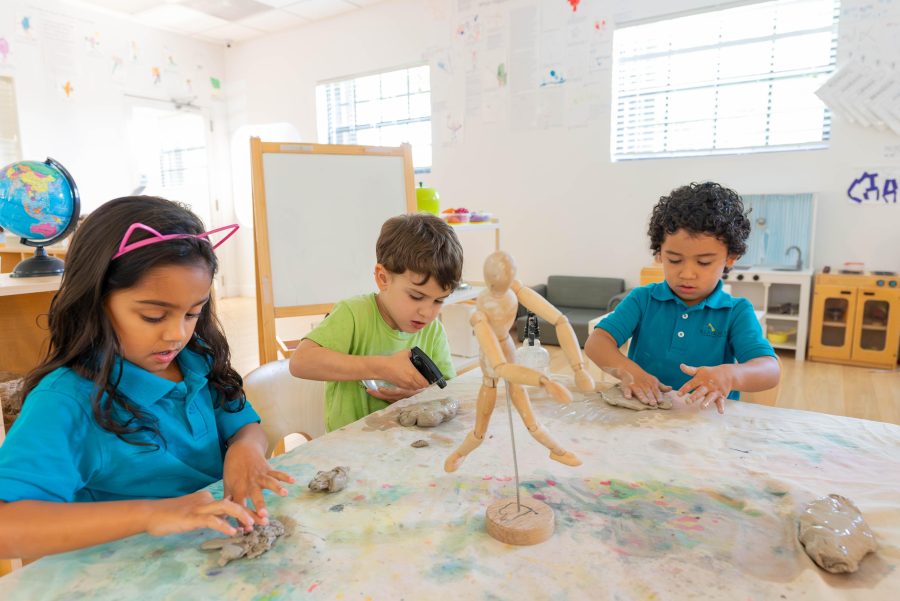
For many parents, choosing a preschool comes down to one practical question: Will this help my child thrive in real life? Families are looking for something deeper; they want a preschool experience that helps their child think independently, respond to challenges with confidence, communicate their ideas, and persist through frustration.
That is one reason child-led learning stands out. When children are encouraged to explore, ask meaningful questions, test ideas, and learn through hands-on experiences, they begin building the kind of real-world problem-solving skills that matter far beyond the classroom. They are not simply completing activities. They are learning how to think, adapt, and respond with growing confidence.
Problem-solving in early childhood does not begin with formal tests or advanced academics. It begins when a toddler tries to fit an object into a container, when a preschooler figures out how to keep a block structure from falling, or when two children work through a disagreement over shared materials.
Research from Harvard’s Center on the Developing Child notes that executive function skills, which are essential for planning, focusing attention, remembering instructions, and adapting strategies, begin developing shortly after birth and grow dramatically between ages 3 and 5. That makes the preschool years a particularly important time to build thinking habits that support lifelong learning.
What Is Child-Led Learning?
Child-led learning is an approach in which children’s questions, interests, observations, and ideas help shape the direction of classroom experiences. This does not mean adults step back completely or leave learning to chance. In an early childhood setting, teachers observe, listen closely, and respond with materials, questions, and experiences that extend children’s thinking in meaningful ways.
This matters because children are more likely to stay engaged when learning feels relevant to them. When they are invited to explore, ask questions, test ideas, and revisit their thinking, learning becomes more active and more memorable. Child-led learning is not the same as unstructured free time. At its best, it is thoughtful, responsive, and developmentally appropriate.
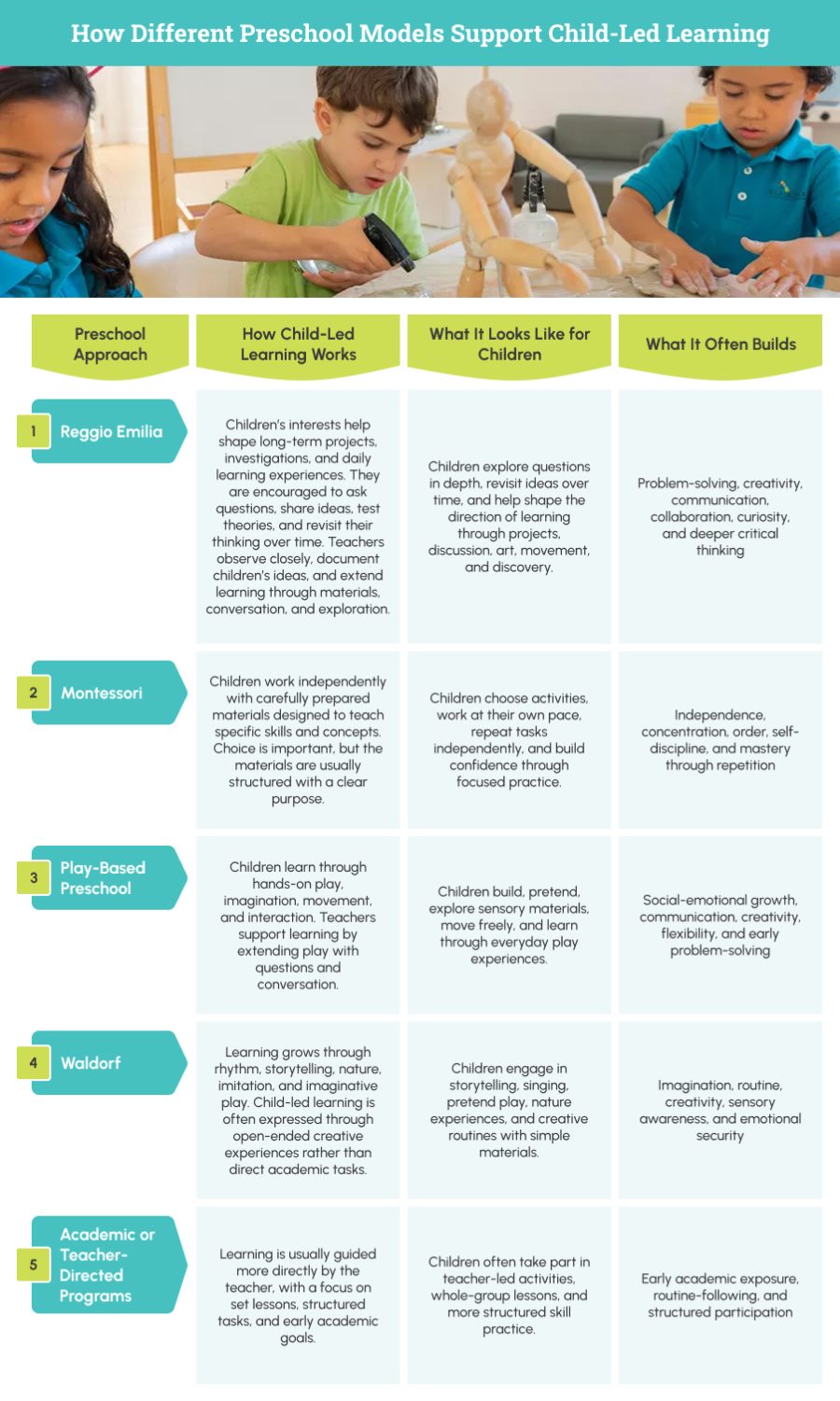
Parents often hear child-led learning mentioned alongside different preschool philosophies, but each approach brings it to life in a different way. Let’s take a closer look at how traditional and alternative preschool models support children’s learning.
Reggio Emilia
In a Reggio Emilia-inspired classroom, children’s interests often help shape long-term projects and investigations. Teachers observe what children are curious about, document their ideas, and use those observations to guide future experiences. The environment, materials, and classroom discussions all play an important role.
For example, if children become interested in shadows, that interest may grow into a larger classroom study through drawing, light exploration, storytelling, movement, and conversation. Learning often feels collaborative, creative, and deeply connected to children’s questions.
Montessori
In a Montessori classroom, child-led learning looks more independent and self-directed. Children usually choose from carefully prepared materials that are designed to teach specific concepts or skills. The teacher gives guidance, but children are often encouraged to work at their own pace and repeat tasks until they feel confident.
For example, a child may choose a practical life activity, a math material, or a sensory task and work with it independently for an extended period. Montessori often supports concentration, order, independence, and self-discipline.
Play-Based Preschool
In a play-based preschool, children learn through hands-on experiences, movement, imagination, and interaction. Teachers create opportunities for exploration and often use play to support language, early math, social-emotional growth, and problem-solving.
For example, children may build a pretend grocery store, create structures with blocks, or explore water and sand while teachers extend the learning through questions and conversation. This approach often feels warm, active, and flexible.
Waldorf
In a Waldorf-inspired preschool, the focus is often on imagination, rhythm, storytelling, nature, and creative play. Learning tends to be gentle and experience-based, with less emphasis on early academics and more attention to sensory richness, routine, and imitation.
For example, children may spend time baking, gardening, hearing stories, singing, or engaging in open-ended pretend play with simple natural materials. This approach often appeals to families who want a calmer, more nurturing early childhood environment.
Academic or Teacher-Directed Programs
In more traditional preschool settings, learning is often guided more directly by the teacher. Activities may follow a set plan, and children may spend more time working on pre-academic skills through whole-group lessons, worksheets, or structured tasks.
For example, the teacher may introduce the same letter, number, or theme to the full class at the same time. This approach can feel more predictable and structured, but it may offer less room for children’s interests to shape the learning process.
Why This Matters
For many families, the real question is not which philosophy sounds best, but how a school helps children grow, learn, and solve problems each day.
Some families want a preschool that gives children more independence. Others want more collaboration, more creativity, or more structure. Child-led learning can exist in different forms, but the best programs usually share a few important qualities:
- Children are active participants in learning.
- Teachers are intentional, not passive.
- Exploration is supported with purpose.
- Children have room to ask questions and test ideas.
- Learning feels meaningful rather than purely routine.
That is often where real growth begins. Children are more likely to become confident, curious, and thoughtful learners when they are given both freedom to explore and guidance that helps them go deeper.
What Are Problem-Solving Skills?
Problem-solving skills are the mental, social, and emotional tools children use to recognize a challenge, try an approach, adjust when needed, and work toward a solution. In early childhood, these skills include noticing patterns, remembering steps, testing ideas, comparing results, using language to explain thinking, waiting for a turn, negotiating with peers, and trying again after frustration.
For young children, problem-solving is not limited to academic tasks. It develops through everyday experiences that ask them to think, respond, and adapt. A child solving a disagreement with a classmate, figuring out how to carry water across a sensory table without spilling it, or deciding which material will make a stronger bridge is using practical thinking in a meaningful way.
This is helpful for parents because it shows that problem-solving is much broader than reading readiness or early math alone. It supports communication, self-regulation, persistence, flexibility, and confidence. These are the same qualities children rely on in the classroom, in friendships, and in daily life.
How Problem-Solving Skills Develop from Birth to Age 5
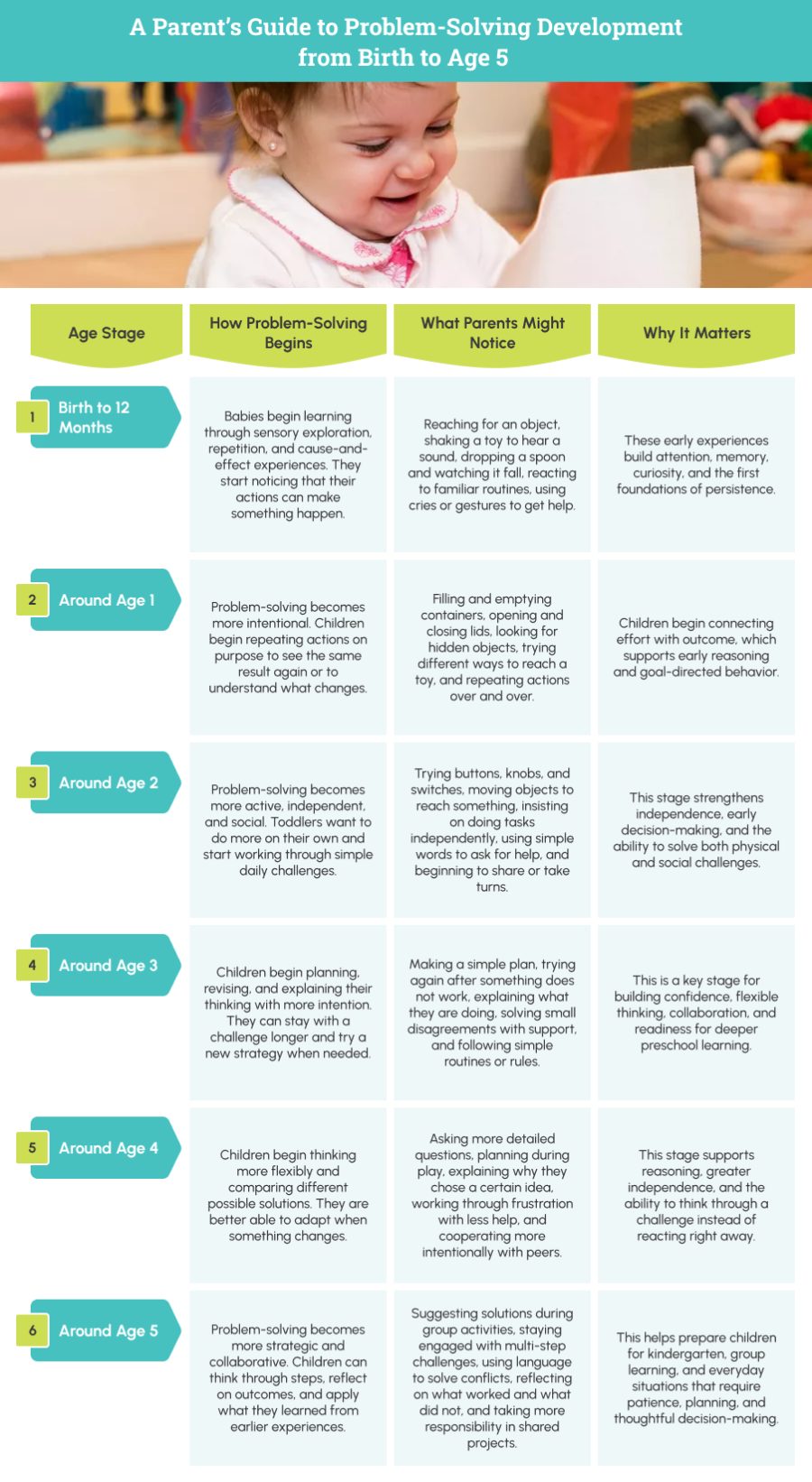
Problem-solving starts much earlier than most parents expect. It does not begin when children are old enough for structured academics. It begins in everyday moments, when babies and young children explore, test, repeat, question, and figure out how the world works.
From infancy through age 5, children build problem-solving skills step by step. What may look simple to adults is often meaningful learning for a young child.
Birth to 12 Months: The Earliest Building Blocks of Problem Solving
During the first year of life, babies are already learning through exploration. They watch faces, reach for objects, respond to sounds, and begin to notice that their actions can make something happen.
A baby may shake a toy and hear a sound, drop a spoon and watch it fall, or reach again for something that rolled away. These small moments are early forms of problem-solving because they help babies connect action with outcome.
At this stage, problem-solving often looks like:
- Reaching for an object that is slightly out of reach
- Repeating an action to see if the same thing happens again
- Exploring textures, sounds, and movement
- Using cries, gestures, or facial expressions to get help
- Showing curiosity about how people and objects respond
These early experiences help build attention, memory, persistence, and cause-and-effect thinking.
Around Age 1: Curiosity Becomes More Intentional
Around age 1, children begin experimenting in more obvious ways. They do not just explore randomly. They start repeating actions on purpose, especially when they want to see a result again.
Parents often notice this in everyday routines. A child may drop objects from a high chair again and again, open and close lids, fill and empty containers, or search for a favorite toy that has been hidden.
At this age, children are beginning to:
- Test what happens when they repeat an action
- Look for hidden objects
- Use movement in new ways to reach something they want
- Use sounds or gestures more intentionally
- Stay focused longer when something interests them
This is the stage where early persistence becomes easier to see. Children are starting to understand that they can try something, notice the result, and try again.
Around Age 2: Problem-Solving Becomes More Active and Independent
Around age 2, problem-solving becomes much more visible. Toddlers are more mobile, more verbal, and much more determined to do things on their own. They often want to figure things out without adult help, even when the task is challenging.
A 2-year-old might try different ways to open a box, move a chair closer to reach something, test buttons on a toy, or insist on completing a task independently. This is also the age when children begin solving more social problems, not just physical ones.
At this age, children are beginning to:
- Trying different ways to make something work
- Using simple language to ask for help or explain what they want
- Showing preferences about how something should be done
- Solving small everyday challenges with less adult support
- Beginning to work through sharing, waiting, and taking turns
This growing independence is an important part of problem-solving development. Children are learning not only how to act, but how to act with intention.
Around Age 3: Children Begin Planning, Revising, and Explaining
Around age 3, children begin to show much more thought in the way they approach challenges. They can often follow simple directions, remember familiar routines, and try a new strategy when the first one does not work.
This is when problem-solving starts to look more purposeful and more connected to language. Children are better able to explain what they want to do, notice why something failed, and try again with a different plan.
At this age, children are beginning to:
- Make a simple plan before starting
- Explain what they are trying to do
- Try a second idea when the first one fails
- Work through small disagreements with support
- Connect actions and outcomes more clearly
- Stay engaged with a challenge for longer periods
This stage matters because it prepares children for the richer, more collaborative kind of problem-solving they experience in preschool.
Around Age 4: Children Begin Thinking More Flexibly
Around age 4, many children can handle more complex challenges with greater independence. They can hold an idea in mind longer, follow steps more easily, and begin adjusting their thinking when circumstances change.
This is also the age when many children start asking more detailed questions and looking for explanations, not just answers. They want to understand why something works, why something changed, or why one idea seems better than another.
At this age, children are beginning to:
- Compare different solutions to the same problem
- Plan during play or projects
- Work through frustration with less immediate help
- Cooperate more intentionally with peers
- Explain their reasoning in greater detail
- Adapt when a plan needs to change
This growth is especially important in a child-led preschool setting, where children are encouraged to think independently, revisit ideas, and take a more active role in their learning.
Around Age 5: Problem Solving Becomes More Strategic and Collaborative
Around age 5, children often begin showing more reasoning, patience, and greater confidence when faced with a challenge. They can usually stay with an activity longer, consider more than one possibility, and contribute more fully to shared investigations or projects.
At this age, children are often more able to connect past experiences to new situations. They may remember what worked before, apply that knowledge in a different context, and explain their thinking more clearly to others.
At this age, children are beginning to:
- Think through a problem before acting
- Suggest possible solutions during group work
- Reflect on what worked and what did not
- Take more responsibility in collaborative tasks
- Solve simple conflicts using language instead of impulse
- Stay engaged with multi-step challenges
This is a meaningful stage because children are becoming more prepared for the kind of problem-solving that supports both kindergarten readiness and everyday life. They are not only reacting to situations. They are beginning to think through them with more purpose.
Why This Matters
When parents understand how problem-solving skills grow over time, it becomes easier to see why early childhood education should support curiosity, independence, and exploration from the start.
A Reggio Emilia-inspired preschool builds on what children are already beginning to do naturally. It gives them more opportunities to ask questions, test ideas, solve everyday challenges, and learn through hands-on experiences that feel meaningful.
That is how early problem-solving grows, from a baby reaching for a toy to a 5-year-old planning, revising, collaborating, and thinking with confidence.
The Importance of Problem-Solving Skills in Early Childhood
Problem-solving skills often receive less attention than literacy or numeracy, yet they are just as important in early childhood. When children learn how to persist, adapt, and work through frustration, they are building the foundation for success across every area of development.
These skills shape much more than classroom learning. They help children manage emotions, stay engaged with a challenge, cooperate with others, and make thoughtful choices in everyday situations. A child who can pause, rethink, and try again is developing abilities that support not only kindergarten readiness, but also friendships, teamwork, and independence.
This is why child-led learning can be so effective. When children are active participants in their learning, and when teachers guide that process with care, they have more opportunities to ask questions, test ideas, and make sense of what they are experiencing. That kind of learning strengthens the thinking habits behind practical problem-solving.
These abilities matter even more in a world increasingly shaped by AI. As technology becomes part of daily life, children will need more than technical exposure. They will need to think critically, adapt to change, collaborate with others, and make good judgments about the information and tools they use. Problem-solving skills help children become thoughtful, capable learners who can use technology wisely rather than depend on it. That emphasis on critical thinking, adaptability, emotional regulation, and collaboration is a key part of preparing children for an AI-driven future.
For families choosing a preschool, this is worth remembering: problem-solving skills support academic growth, emotional development, and everyday confidence. They help children become more capable learners, more resilient people, and better prepared for the future they are growing into.
How the Reggio Emilia Approach Encourages Child-Led Learning
The Reggio Emilia approach begins with a powerful belief: children are capable, curious, expressive, and full of potential. In this philosophy, children’s interests are not seen as distractions from learning. They are often the starting point for it.
That is one reason this approach is so closely connected to child-led learning. Instead of moving every child through the same activity in the same way, the classroom grows from observation, inquiry, and shared discovery. Children’s questions matter. Their ideas are taken seriously. Their thinking helps shape the direction of learning.
Teachers play an active but thoughtful role in this process. They do not simply give answers or control every step. They observe what children are exploring, listen carefully to their words, document what they notice, and introduce materials or questions that help extend the experience. This makes the learning process responsive rather than rigid.
The environment also plays an important role. Reggio Emilia-inspired classrooms are often designed to invite experimentation, collaboration, and reflection. Open-ended materials, natural elements, flexible spaces, and visible documentation all support children as they test ideas, revisit their thinking, and make connections over time.
This approach encourages child-led learning because it gives children meaningful opportunities to:
- Ask questions and follow their curiosity
- Explore ideas through hands-on experiences
- Revisit a topic instead of moving on too quickly
- Express their thinking in different ways
- Collaborate with peers during shared projects
- Make choices within a thoughtfully prepared environment
- Build confidence through investigation and discovery
For parents, this helps explain why child-led learning in a Reggio Emilia setting often feels so rich and engaging. The goal is not simply to keep children busy. It is to help them become thoughtful participants in their own learning.
How Real-World Problem Solving Grows Through Everyday Preschool Experiences
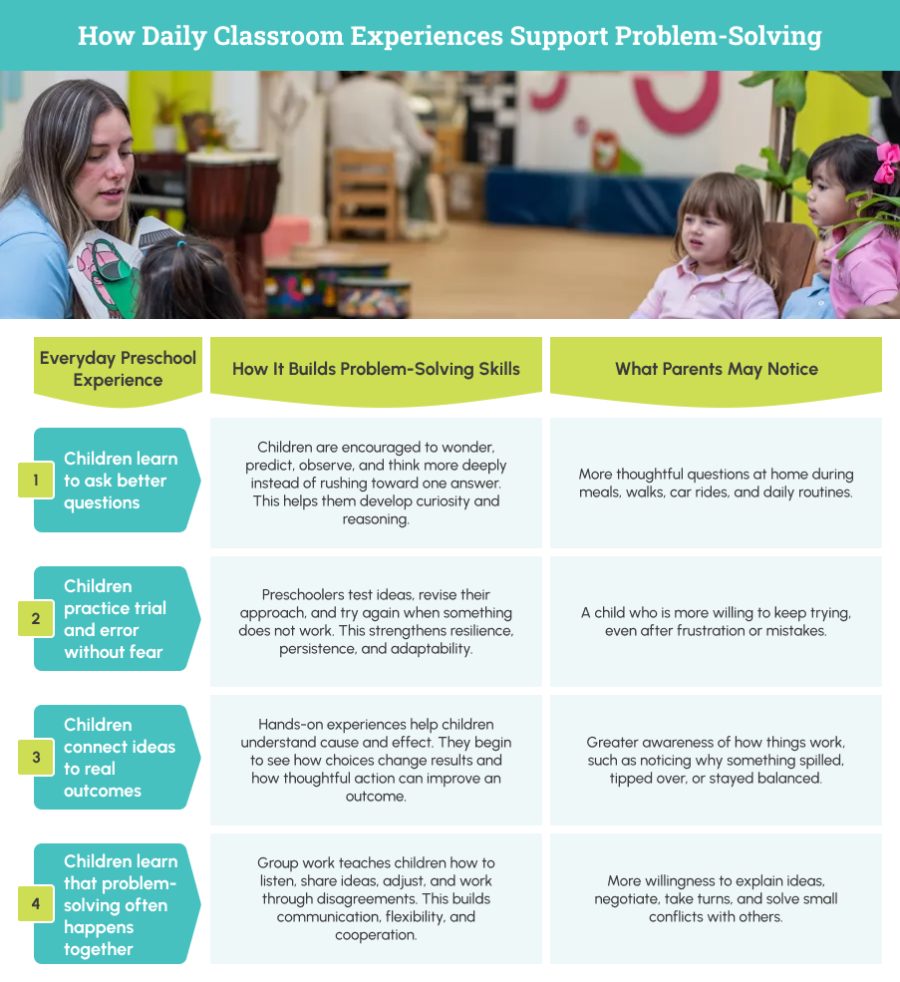
What makes child-led learning so powerful is that problem-solving becomes part of everyday life in the classroom. Children are not only completing activities. They are learning how to question, investigate, adjust, and work through challenges as they happen.
Children Learn to Ask Better Questions
Problem-solving starts with curiosity. In child-led settings, children are encouraged to wonder out loud, make predictions, and notice what seems unusual or interesting. Rather than being rushed toward a single answer, they are invited to think more deeply. This helps preschoolers develop one of the most important lifelong skills: the ability to ask meaningful questions.
A child might wonder why one plant is growing faster than another. Another may ask why certain building materials feel stronger. Someone else may question why two classmates solved the same challenge in different ways. These moments are powerful because they teach children that questions are valuable. For parents, this often shows up at home as richer conversation. Children begin asking more thoughtful questions during meals, car rides, walks, and family routines.
Children Practice Trial and Error Without Fear
Many real-life challenges do not work out on the first try. Young children need opportunities to experience that truth in supportive ways. A child-led Reggio Emilia classroom allows room for experimentation. A bridge collapses. A structure leans. A plan does not work. Instead of seeing that result as failure, children are encouraged to revise, test, and try again.
Parents often say they want their children to become confident, but confidence does not grow from getting everything right immediately. It grows when children discover they can handle mistakes, think through obstacles, and continue learning. That is one of the greatest gifts of child-led learning. It normalizes effort, persistence, and adaptation.
Children Connect Ideas to Real Outcomes
Preschoolers learn best when experiences are concrete and meaningful. In a Reggio Emilia preschool, learning is grounded in exploration with real materials, natural elements, and hands-on discovery.
They notice what happens when too much water is poured into one container. They compare which materials absorb liquid and which repel it. They see how a base needs support before a tall structure can stand. They recognize that working together changes what is possible. These are real-world lessons. They help children understand that choices have consequences and that thoughtful action leads to better results.
Children Learn That Problem Solving Often Happens Together
Not every challenge in preschool is about objects, building, or science. Many of the most important problem-solving moments happen between children. In a Reggio Emilia-inspired classroom, preschoolers learn how to share ideas, listen to different perspectives, and work through small conflicts in productive ways. Two children may want the same materials. A group may disagree about how to build something. One child may have an idea that changes the direction of a project.
These situations teach children that problem-solving is not always something they do alone. Sometimes it requires cooperation, communication, flexibility, and patience. Parents often hope their children will become confident and independent, but they also want them to be thoughtful, respectful, and able to work well with others. Child-led learning supports both. It helps children develop their own ideas while also learning how to adjust, collaborate, and find solutions as part of a group. For many families, this is one of the most valuable parts of a Reggio Emilia preschool experience. Children are not only learning how to think. They are learning how to think with others.
What Problem Solving Looks Like in the Classroom for Preschool-Age Children
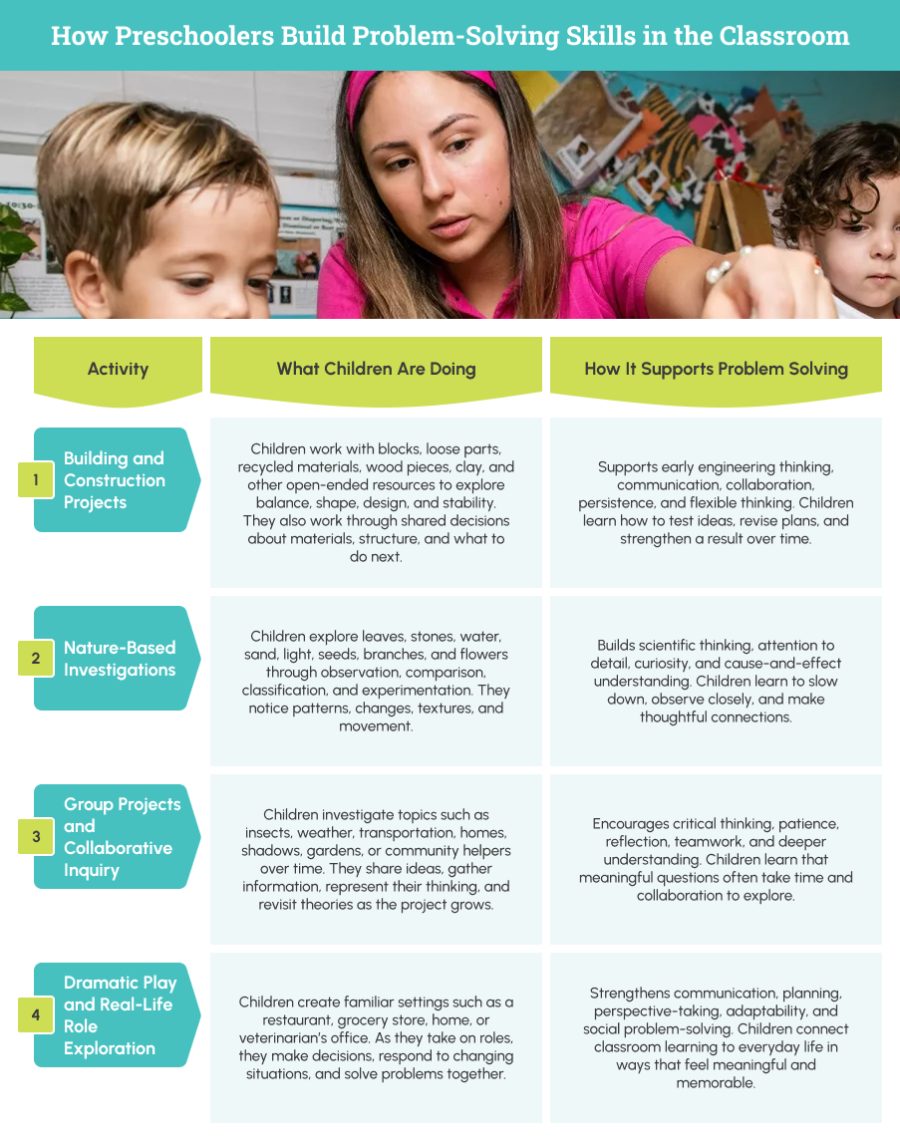
Problem-solving in preschool is often easier to understand through real classroom examples. From building projects to collaborative investigations, child-led learning gives children daily opportunities to think, adapt, communicate, and work through challenges in meaningful ways.
Building and Construction Projects
Children may work with blocks, loose parts, recycled materials, wood pieces, clay, or other open-ended resources. During these projects, they explore balance, shape, design, and stability.
They also solve social problems. Who will use which materials? What happens when two ideas conflict? How can the structure become stronger? What should change next? A simple building experience can strengthen early engineering thinking, communication, collaboration, and persistence all at once.
Nature-Based Investigations
Natural materials are central in many Reggio Emilia-inspired environments. Leaves, stones, water, sand, light, seeds, branches, and flowers all invite observation and experimentation.
Children compare textures, classify objects, test movement, observe growth, and discuss patterns in the natural world. These experiences build scientific thinking in an age-appropriate and engaging way. They also help children slow down and pay attention, which is an essential part of solving problems well.
Group Projects and Collaborative Inquiry
Longer investigations are common in Reggio Emilia classrooms. A class may become interested in insects, transportation, weather, homes, shadows, gardens, or community helpers.
As the project develops, children contribute ideas, gather information, represent their thinking through art and discussion, and revisit their theories over time. This process teaches children that solving complex questions often takes time. It also shows them that learning can be collaborative rather than solitary.
Dramatic Play and Real-Life Role Exploration
Pretend play is another important way preschoolers build problem-solving skills. In a Reggio Emilia-inspired classroom, children may create a restaurant, a home, a grocery store, a veterinarian’s office, or another familiar setting drawn from everyday life.
As they take on roles, they begin making decisions, responding to new situations, and working through problems together. Who will be the customer? What happens if the restaurant runs out of food? How should the group organize the space? What does the baby need in the pretend home? These moments strengthen communication, perspective-taking, planning, and flexibility. They also help children connect classroom learning to the real world in a way that feels meaningful and memorable.
The Teacher’s Role in Supporting Independence Without Leaving Children on Their Own
Parents sometimes wonder whether child-led learning offers enough structure, especially when they are comparing different preschool models. It is a fair question. The child-led classrooms are not unstructured. They are thoughtfully guided.
Teachers play an important role in child-led learning. They observe, listen closely, and pay attention to how children interact with materials, ideas, and one another. They notice when a child is ready for a new challenge, when a question can deepen learning, and when it is best to step back and let the thinking continue.
Too much adult direction can limit initiative and reduce opportunities for original thinking. Too little support can leave learning feeling shallow or disconnected. Skilled teachers create the conditions for children to explore independently while still feeling supported, challenged, and understood.
In a child-led classroom, teachers often:
- Observe before stepping in
- Ask open-ended questions that deepen thinking
- Prepare materials with purpose
- Create spaces that invite exploration
- Support children without taking over
- Help children revisit ideas and discoveries over time
For parents, this is an important point to notice during a school visit. A rich child-led classroom should feel calm, purposeful, and responsive. Children should seem engaged and active in their learning, while teachers remain present, intentional, and deeply attuned to what is happening around them.
Involving Families in Child-Led Learning
Family involvement plays an important role in child-led learning because children grow most when home and school work together. When families understand what children are exploring in the classroom, they are better able to support that learning in meaningful ways.
This partnership often grows through documentation, conversations with teachers, classroom events, and regular communication about what children are noticing, creating, and questioning. These moments help parents see more than a finished activity. They help families understand how a child is thinking, what interests are developing, and how learning is unfolding over time.
That perspective is especially valuable in child-led environments. Much of the growth happens in the process, through questions, experiments, conversations, and repeated attempts, not only in the final result.
Parents can support this kind of learning in simple but powerful ways:
- Share their child’s interests with teachers
- Ask about current classroom projects or investigations
- Revisit ideas from school at home through books, conversation, or play
- Treat everyday questions as opportunities to think together
- Notice and encourage curiosity in daily routines
- Stay engaged with classroom communication and documentation
When families and teachers work together, children experience greater continuity between home and school. That consistency helps them feel understood, supported, and more confident in their learning.
For parents, this is an important reminder that involvement does not have to mean doing more. Often, it means paying attention, asking thoughtful questions, and staying connected to what your child is already curious about.
How KLA Schools Bring Child-Led Learning to Life
At KLA Schools, we believe curiosity should lead to meaningful growth. That is why child-led learning is such an important part of our educational experience. Our approach is inspired by the Reggio Emilia philosophy and shaped around hands-on learning, exploration, creativity, and a relationship between children and teachers. We see children as active participants in their own learning, and we design experiences that support their academic, social, and emotional development at every stage.
What makes this especially meaningful for real-world problem solving is the way we connect learning to children’s interests. We observe closely, listen carefully to children’s questions, and build on those interests through projects, conversations, and engaging materials. In our preschool programs, child-led play, guided exploration, collaboration, and hands-on experiences all help children build independence, creativity, and critical thinking.
For parents, this means the learning experience feels active and purposeful rather than passive or routine. Our classrooms are designed to be places where children investigate, experiment, communicate, and make sense of the world with educators who guide and support them along the way.
We also offer age-specific programs from infancy through school age, with preschool experiences designed to meet children where they are developmentally, while nurturing curiosity, independence, and a lifelong love of learning. We see early education as more than preparation for the next stage of school. We see it as the foundation for long-term growth.
Discover What Child-Led Learning Can Look Like for Your Family
If you are looking for a preschool where children are encouraged to ask questions, explore ideas, and grow into confident problem solvers, we invite you to discover KLA Schools. Visit one of our preschools, explore our classrooms, meet our educators, and see how child-led learning comes to life in a warm, thoughtfully prepared environment.
Why Child-Led Learning Leaves a Lasting Impact
Parents do not choose a preschool only for the present moment. They choose it for what it may build over time. That is why child-led learning matters so much. It helps children become active participants in their own education. They begin to understand that their ideas have value, that questions are worth asking, that challenges can be worked through, and that learning is not something that simply happens to them. It is something they help create.
Over time, they can support critical thinking, deeper engagement, greater creativity, and more confident collaboration in school. In daily life, they can support adaptability, independence, and resourcefulness. In relationships, they can support empathy, communication, and patience. In unfamiliar situations, they can help children pause, think, and respond with more intention.
That is why problem-solving in the preschool years deserves real attention. It is not an extra skill or a secondary benefit. It is part of the foundation for lifelong learning.
For families, this is often what makes child-led learning so meaningful. It gives young children the chance to grow into thoughtful, capable problem solvers through experiences that feel natural, engaging, and relevant to how they actually learn. When children are encouraged to explore their own questions, test ideas, revisit their thinking, and work through challenges with supportive teachers, they build more than academic readiness. They build confidence in their ability to understand and respond to the world around them.
A preschool experience grounded in curiosity, exploration, and purposeful support does not rush children through disconnected lessons. It gives them room to think, create, collaborate, and solve meaningful problems in ways that reflect real childhood development.
For many parents, that is exactly the kind of start they hope to give their child.
Sources:
https://developingchild.harvard.edu/resources/inbriefs/inbrief-executive-function/
https://www.researchgate.net/publication/264543281_The_Importance_of_Play_and_Child-Led_Learning
https://www.research-and-play.com/2021/06/tips-for-designing-a-reggio-inspired-classroom.html
https://pubmed.ncbi.nlm.nih.gov/20822435/
https://raisingchildren.net.au/newborns/development/understanding-development/development-first-five-years
https://www.reggiochildren.it/en/reggio-emilia-approach/
https://www.researchgate.net/publication/394136270_Project-Based_Learning_to_Improve_Problem_Solving_Skills_in_Early_Childhood
https://www.nextgenlearning.org/articles/real-world-projects-challenge-students-and-teachers
https://www.naeyc.org/resources/pubs/yc/summer2022/power-playful-learning
https://mentorscollective.com/preparing-children-for-an-ai-driven-future/