The Rise of Alternative Preschool Models Across the U.S.
Key findings:
- Preschools across the U.S. are shifting from teacher-led academics to environments that prioritize creativity, connection, and whole-child development.
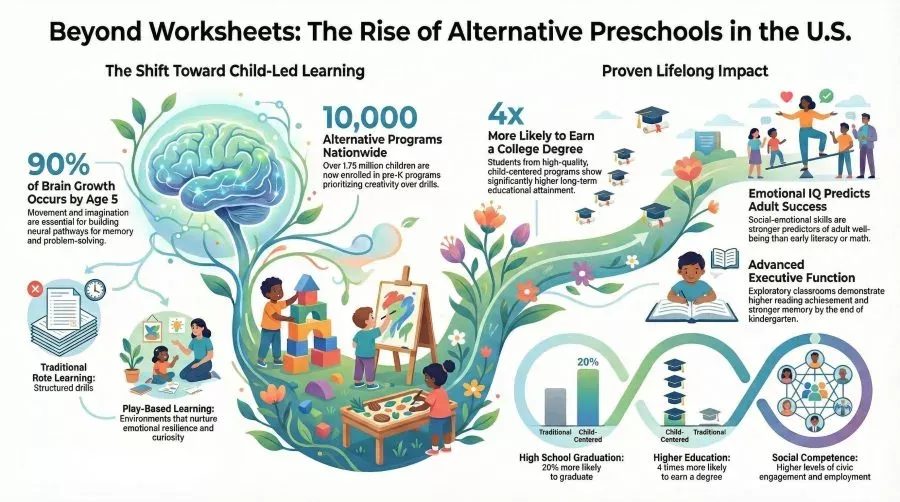
- More than 1.75 million children attended state-funded preschool programs during the 2023–2024 school year, part of over 40,000 public and private pre-K programs nationwide.
- Alternative preschool models, including Reggio Emilia, Montessori, and nature-based schools, are proliferating, with an estimated 10,000 programs now operating nationwide.
- The first five years account for up to 90% of brain growth, making play, movement, and imagination essential for building memory, focus, and problem-solving skills.
- Traditional preschools once focused on early reading, math, and structure, but many families are now seeking programs that prioritize curiosity, creativity, and emotional growth.
- Children in high-quality, child-centered programs are up to 20% more likely to graduate from high school and 4 times more likely to earn a college degree than their peers.
- Children in child-led, relationship-rich early learning environments exhibit measurable advantages in education, employment, and overall well-being that persist into adulthood.
- Students in exploratory and self-directed classrooms demonstrate higher reading achievement, stronger memory, improved executive function, and greater social understanding during their early school years.
- Early environments that emphasize collaboration, play, and self-expression build empathy, cooperation, independence, responsibility, and resilience. Skills that predict adult well-being more strongly than early literacy or math skills.
- Open-ended, curiosity-driven play strengthens executive function, self-regulation, and communication, laying the groundwork for lifelong confidence and adaptability.
What Inspired This Case Study
In every classroom, on the playground, and in conversations with families, we continue to witness one simple yet profound truth: childhood curiosity has the transformative power to shape lives. When children are encouraged to wonder, create, and explore, learning becomes joyful, and that joy becomes the foundation for confidence, empathy, and lifelong growth.
This case study was inspired by those everyday moments of discovery. Rooted in our work with parents, educators, and communities who share our vision for a more meaningful early education, this exploration examines how alternative preschool models across the United States are redefining what it means to learn and grow. Our goal is to empower families and educators with insight into environments that nurture creativity, connection, and emotional well-being.
Drawing on research and real-world examples, this case study demonstrates that when children are given the freedom to explore and express themselves, they develop not only strong academic skills but also the compassion, resilience, and curiosity to shape a better world.
Understanding the Shift in Early Education
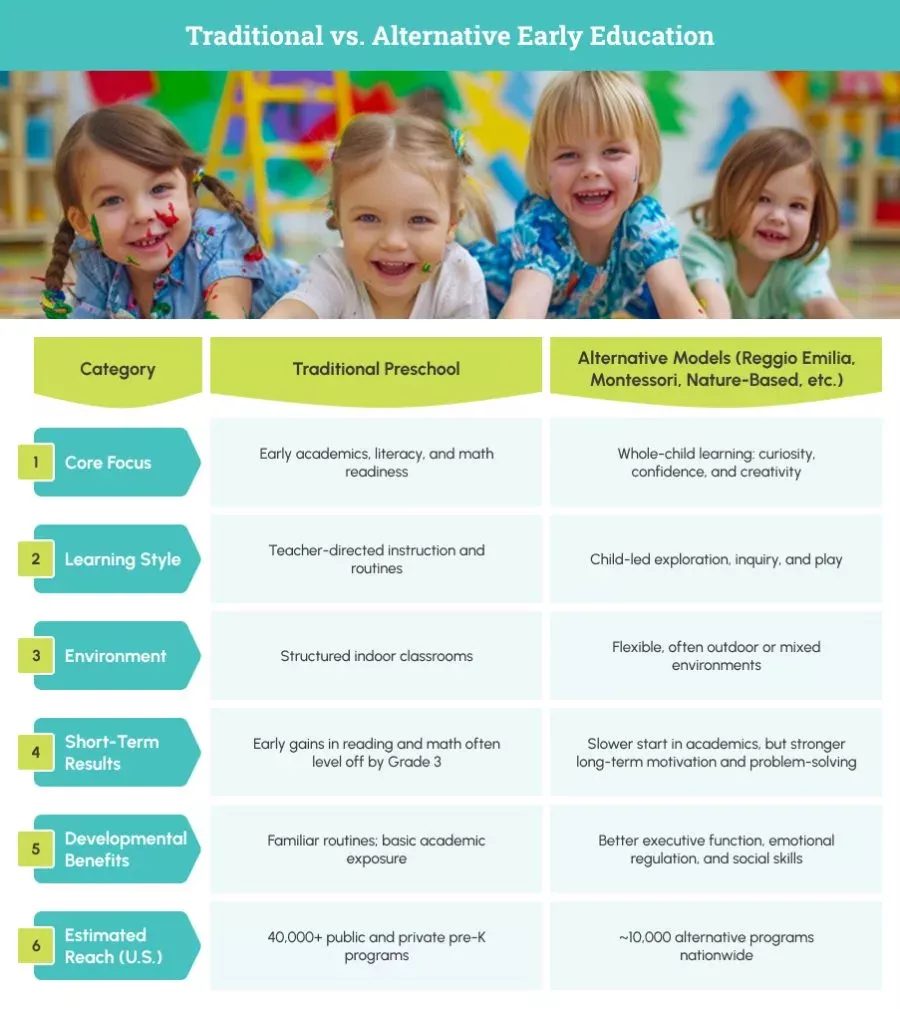
Across the United States, early childhood education is undergoing a quiet transformation. Once seen mainly as preparation for kindergarten, preschool is now recognized as a critical period for brain and social development. According to The State of Preschool Yearbook 2024, released by the National Institute for Early Education Research (NIEER), more than 1.75 million children attended state-funded preschool programs during the 2023–2024 school year, setting a new national record. These students were enrolled across the nation’s 40,000-plus public and private pre-K programs, highlighting continued progress in expanding access to early childhood education. At the same time, enrollment in alternative programs continues to grow, with an estimated 10,000 alternative preschools now operating nationwide.
This shift reflects a growing understanding of the critical importance of early childhood. The first five years of life account for up to 90% of brain development, and neuroscience confirms that play, movement, and imagination are crucial for building the neural pathways essential for memory, focus, and problem-solving. Long-term studies from the HighScope Perry Preschool and the Abecedarian Project show that children who participate in high-quality early learning programs are up to 20 % more likely to graduate from high school and approximately 4 times more likely to earn a college degree than their peers.
Why Families Are Turning Away From Traditional Preschool
For decades, traditional preschools promised a head start with early reading, math, and structured routines. But families are rethinking what that means. The Harvard Center on the Developing Child notes that children learn best through play and exploration, rather than through drills and rote learning. Studies from NIEER indicate that early academic gains in traditional preschools often fade by the third grade, while stress and disengagement can increase. The pandemic intensified this shift, as remote learning exposed the limitations of passive instruction in meeting the needs of young children.
“We switched to a play-based, outdoor preschool after seeing how anxious our daughter became in a more academic setting,” said Lena Morales, a parent from Florida. “Now she’s curious, confident, and excited to learn again.”
Today, health, well-being, and connection are driving new choices. Smaller, child-led programs, such as Reggio Emilia, Montessori, and nature-based preschools, emphasize movement, creativity, and collaboration. Qualities tied to stronger executive function and emotional resilience. Rather than pushing academics early, families are embracing models that grow the skills children need for both school and life.
The Most Influential Alternative Preschool Models in the U.S.
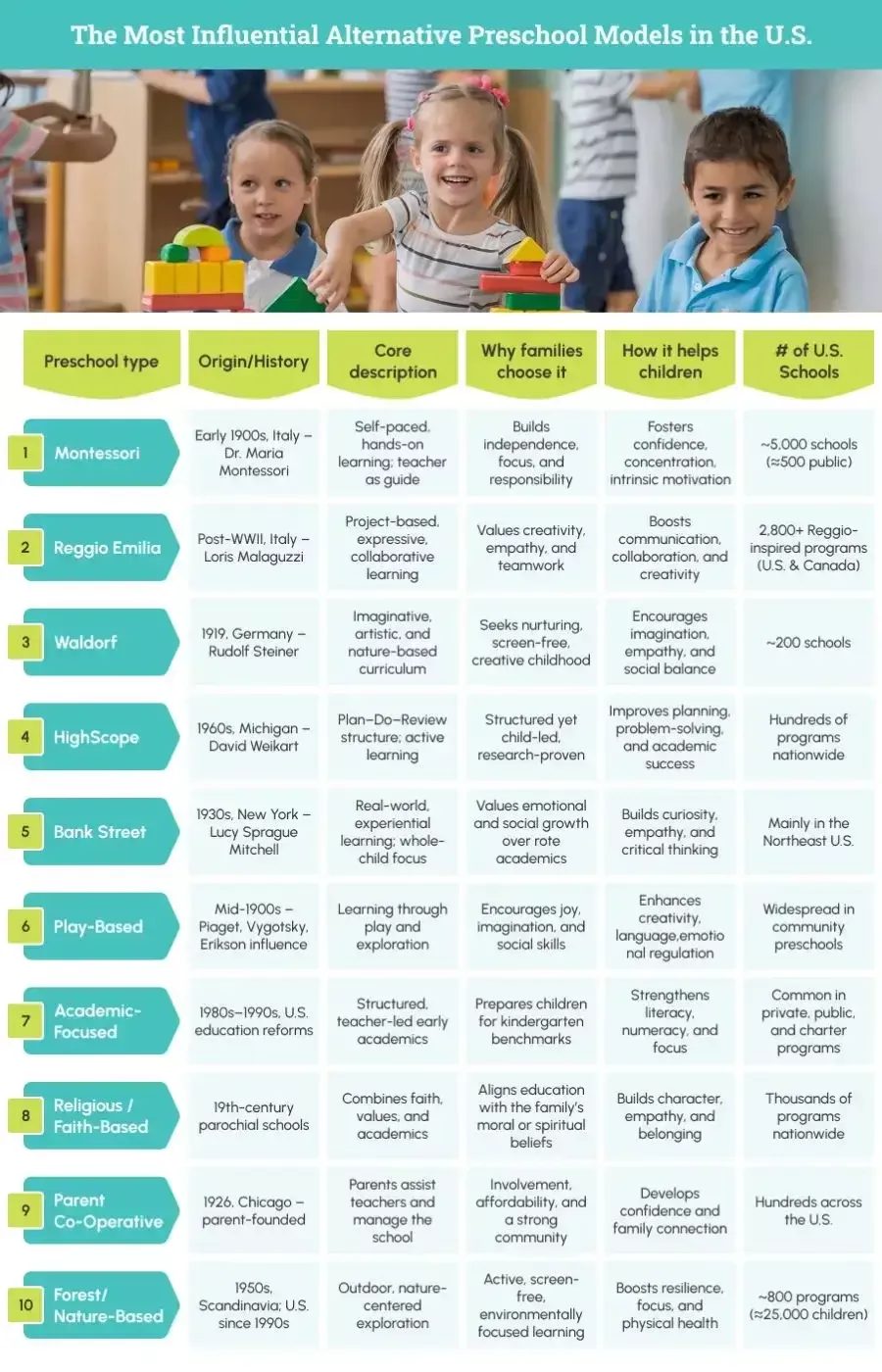
As families explore new early learning options, several models stand out for their longevity, research support, and nationwide presence. Among the most widely adopted are Reggio Emilia, Montessori, forest/nature schools, and play-based preschools. Each represents a distinct philosophy of childhood learning, but all share one goal: helping children grow into confident, curious, and capable individuals.
1. Montessori
Developed in the early 1900s by Dr. Maria Montessori, one of Italy’s first female physicians, the Montessori approach is founded on the belief that children learn best through self-directed, hands-on experiences. In calm, carefully prepared classrooms, they move freely, choose meaningful work, and cultivate independence, focus, and self-discipline, skills that last well beyond childhood. Approximately 5,000 Montessori schools operate across the United States, including around 500 public programs that uphold Montessori’s vision of empowering children through purposeful exploration.
2. Reggio Emilia
Originating in Reggio Emilia, Italy, after World War II, this approach was developed by educator Loris Malaguzzi, and local parents determined to rebuild their community through education. Rooted in creativity, collaboration, and respect for the child’s voice, Reggio-inspired classrooms invite exploration through art, music, storytelling, and movement, what Malaguzzi called “the hundred languages of children.” Teachers guide and document learning while the environment itself acts as a “third teacher,” nurturing curiosity and connection. Approximately 2,800 Reggio-inspired schools and programs operate across the U.S. and Canada, fostering empathy, imagination, and teamwork alongside academic growth and critical thinking.
3. Waldorf
Founded in 1919 in Germany by philosopher and educator Rudolf Steiner, the Waldorf approach began as a preschool for the children of factory workers at the Waldorf-Astoria Cigarette Company. Grounded in Steiner’s belief that education should nurture the whole child: head, heart, and hands. It emphasizes imagination, rhythm, and the arts. In early childhood settings, learning unfolds gradually through play, storytelling, music, and time spent in nature, allowing creativity and wonder to guide discovery. Approximately 200 Waldorf schools operate across the United States, both private and public, carrying forward Steiner’s vision of educating the whole human being through creativity, connection, and care.
4. HighScope
The HighScope approach originated from the landmark Perry Preschool Project, developed in the 1960s in Ypsilanti, Michigan, by psychologist David Weikart, which demonstrated the lasting benefits of active, hands-on learning in early childhood. HighScope classrooms use a structured Plan–Do–Review cycle, where children plan their activities, carry them out, and reflect with teachers on their experiences. This rhythm fosters independence, decision-making, and a clear sense of how actions lead to outcomes. The HighScope model is implemented in hundreds of preschools and Head Start programs across all 50 states and is recognized as one of the most research-backed approaches to early learning in the country.
5. Bank Street
In the 1930s, at the Bank Street College of Education in New York City, Lucy Sprague Mitchell, a pioneer in progressive child development, developed the Bank Street approach. Grounded in her “developmental-interaction” philosophy, it links classroom experiences to the real world through exploration, discussion, and reflection. Teachers observe closely and guide learning according to each child’s interests and stage of growth. The Bank Street philosophy continues to shape schools and teacher education programs across the Northeast and beyond, carrying forward Mitchell’s vision of learning through experience and connection.
6. Play-Based Preschools
Play-based learning emerged in the mid-20th century, rooted in the developmental theories of Jean Piaget, Lev Vygotsky, and Erik Erikson. As a result of a growing understanding of how young children think and grow, play-based learning gained prominence in this period. This approach centers on open-ended play, building, pretending, exploring, and experimenting as the primary way children make sense of the world. Teachers serve as gentle guides, extending children’s ideas and linking discoveries to deeper understanding. Play-based learning remains one of the most widely used and trusted preschool approaches in the United States, valued for its balance of freedom, joy, and developmental soundness.
7. Academic-Focused Preschools
Emerging in the 1980s and 1990s, the academic or traditional preschool model grew alongside a national emphasis on kindergarten readiness and early testing standards. These programs are typically structured and teacher-led, focusing on literacy, numeracy, and foundational academic skills through direct instruction and guided lessons. The academic-focused preschool model remains one of the most prevalent in the United States, spanning public, charter, and private pre-K programs nationwide.
8. Religious/Faith-Based Preschools
Rooted in 19th-century parochial traditions, faith-based preschools expanded across denominations and faiths throughout the 20th century, becoming a cornerstone of community education in the United States. These programs blend early academics with spiritual values, moral development, and family engagement, often operating within churches, mosques, synagogues, or community centers. Tens of thousands of faith-based preschools now serve families nationwide, offering education that is grounded in both learning and faith.
9. Parent Co-Operative Preschools
The cooperative, or “co-op,” preschool model began in 1926 in Chicago, when a group of parents sought to take an active role in their children’s early education. Built on collaboration and community, co-op preschools are family-run programs where parents work alongside teachers, participate in classroom activities, and contribute to the guidance of school operations. Play-based learning and family engagement lie at the heart of this approach, fostering strong connections between home and school. Hundreds of cooperative preschools operate across the United States, continuing a nearly century-old tradition of learning through partnerships between families and the community.
10. Forest/Nature-Based Preschools
Coming from Scandinavia in the 1950s and introduced to the United States in the 1990s, the Forest School movement has experienced rapid growth alongside the rise of nature-based education. In these programs, children spend most of their day outdoors, exploring forests, gardens, and natural habitats, and learn through play, observation, and inquiry in all seasons. Teachers serve as facilitators, guiding exploration and encouraging children to take measured risks while building confidence in the natural world. Approximately 800 Forest School programs now serve roughly 25,000 children across the United States, reconnecting early education with the wonder and wisdom of nature.
How Alternative Preschool Models Help Children Thrive
Across the country, more families are embracing early learning programs that look and feel very different from the classrooms many adults remember. These environments are calmer, more curious, and more collaborative. Instead of memorizing letters or reciting lessons, children explore ideas, follow their interests, and learn through authentic experiences.
Decades of research have shown that when young children are allowed to explore, solve problems, and make decisions, they develop the very skills that predict long-term success: curiosity, focus, emotional intelligence, and adaptability.
Parents often ask the big question: Do these alternative approaches really make a difference later in life?
The answer, increasingly, is yes!
Children who attend alternative preschools show lasting academic and social benefits.
An evaluation of the Reggio Emilia Approach found that participation in Reggio-inspired early education programs was associated with higher levels of employment, social and emotional competence, civic engagement, and educational attainment throughout adulthood. These findings highlight how child-led, relationship-rich environments cultivate both academic and life success through nurturing curiosity, collaboration, and confidence from the earliest years.
Supporting this evidence, a national randomized controlled trial published in the Proceedings of the National Academy of Sciences found that children enrolled in public Montessori programs demonstrated higher reading achievement, memory, executive function, and social understanding by the end of kindergarten compared to their peers in traditional classrooms. Similarly, Lillard's research found that preschoolers who engaged in hands-on, self-directed learning showed stronger academic performance, social cognition, and self-regulation. Together, these studies affirm that exploratory, child-centered early education, whether Reggio Emilia, Montessori, or similar models, builds enduring foundations for academic and personal growth.
Children who attend alternative preschools are more likely to graduate from high school and attend college.
Studies from the HighScope Perry Preschool Project, which tracked participants for more than 40 years, and research from the Abecedarian Project found that children who attended nurturing, play-based, and relationship-rich early education programs were up to 20 % more likely to graduate high school and about 4 times more likely to earn a college degree than their peers who did not.
These long-term findings underscore that the benefits of high-quality, child-centered preschool extend far beyond early childhood, positively shaping education, career opportunities, and overall life outcomes well into adulthood.
Children who attend alternative preschools develop greater social and emotional skills, which can lead to lifelong success.
Academic readiness is only part of the picture. The Center on the Developing Child at Harvard University reports that early social and emotional skills are stronger predictors of adult well-being than early literacy or math ability. Classrooms that emphasize collaboration, play, and self-expression help children build empathy, cooperation, independence, responsibility, and resilience. These are skills that shape both personal and academic growth.
Another report from the Center on the Developing Child at Harvard University found that children engaged in open-ended play and inquiry display higher levels of curiosity and persistence. A study by the American Academy of Pediatrics, “The Power of Play: A Pediatric Role in Enhancing Development in Young Children” (2018), identifies play as “a cornerstone of healthy development,” supporting the development of executive function, self-regulation, and communication.
Lifelong Impact: From Curiosity to Confidence
Over time, the benefits of early, child-centered education accumulate. Children who start in supportive, curiosity-driven environments tend to remain motivated learners, stay in school longer, and pursue higher education at greater rates. They also report stronger self-confidence and emotional resilience as adults.
Across thousands of programs nationwide, this movement is quietly redefining what early learning means. Instead of drilling facts and worksheets, young children are learning how to explore, connect, and imagine, and that may be the best preparation for the world ahead.
KLA Schools: A Model of Best Practice in Early Childhood Education
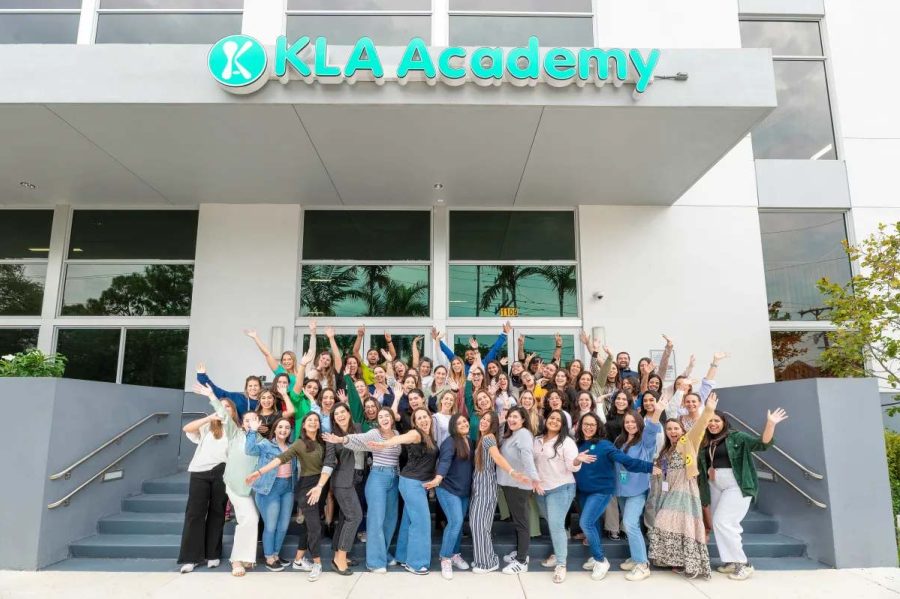
Among the most forward-thinking Reggio Emilia–inspired organizations in the United States, KLA Schools was founded in Miami in 2008 to bring a modern, research-informed interpretation of the Reggio approach to American families. Guided by the belief that children are capable, curious, and creative, KLA Schools has grown into a vibrant network of early learning communities serving infants through kindergarten. Its mission is simple yet powerful: to empower children, honor their individuality, and create environments where every learner feels seen, supported, and inspired.
With more than 30 locations nationwide, and several new schools currently in development. KLA Schools combines innovative learning spaces, dedicated educators, strong community connections, and active parent involvement, extending learning well beyond the classroom. When parents choose a preschool, they’re looking for a place that nurtures both the mind and the heart; KLA Schools provides that balance through focus on creativity, collaboration, and confidence from the start.
KLA’s impact extends beyond early childhood. Graduates enter elementary school with confidence, curiosity, and a strong sense of self, qualities that help them thrive both academically and personally. This strong foundation is reflected in the many students who go on to attend some of the most prestigious schools.
“We’re proud to see our graduates transition into elementary school not just prepared, but excited to learn,” says a teacher from KLA Schools. “They carry forward the confidence, empathy, and curiosity they developed here, and those traits serve them beautifully in school and in life.”
Through its commitment to quality, collaboration, and creativity, KLA Schools demonstrates how early education can nurture the whole child and lay the foundation for a lifetime of learning and growth.
A New Era for America’s Youngest Learners
Early education in the United States is quietly transforming into one that puts curiosity, creativity, and connection at the center of the learning experience. From Reggio Emilia and Montessori classrooms to nature-based and play-driven programs, an increasing number of schools are reimagining what it means to prepare children for the future. These environments trade worksheets for wonder, giving children space to explore, ask questions, and discover how the world works through hands-on experience.
Children who begin their journeys in these settings don’t just learn facts; they know how to think critically. They develop confidence, empathy, and resilience, qualities that last long after preschool. This movement is reshaping the very idea of “school readiness,” shifting the focus from how early a child can read to how deeply they can imagine, connect, and care. The classrooms of the future are already here, places where play sparks learning, relationships build strength, and every child is encouraged to grow with curiosity and joy.