How a Reggio Emilia-Inspired Supports Children’s Language Development
Topics: School Life
Age Range: Preschool
Language development is a central element of early childhood learning and childcare in West Palm Beach. Within a Reggio Emilia–inspired approach, it is viewed as far more than the acquisition of words. Language is understood as a foundation for thinking, expressing ideas, building relationships, and making meaning of the world. When families understand the importance of the right preschool curriculum, they can better appreciate how educational philosophies like Reggio Emilia support communication, creativity, and cognitive growth from an early age. Often described as part of the “hundred languages of children,” language development is supported through rich interactions, purposeful exploration, and collaborative learning rather than isolated instruction. Understanding the benefits of the Reggio Emilia approach offers valuable insight into how young children learn, connect, and grow during their earliest years.
Language as a social and relational process
In Reggio Emilia-inspired daycares and preschools, language develops primarily through relationships. Children are encouraged to communicate with educators and peers in meaningful, authentic contexts. Educators listen attentively, ask open-ended questions, and engage in sustained conversations that invite children to explain their thinking, reflect on experiences, and build ideas together. This emphasis on dialogue supports vocabulary development, sentence structure, and confidence in self-expression.
Rather than correcting children’s language, educators model rich and accurate language by expanding on children’s words and ideas. This respectful approach validates the child’s voice while gently strengthening expressive and receptive language skills.
Storytelling, documentation, and reflection
Storytelling plays a vital role in supporting language development within a Reggio Emilia-inspired environment. Children are encouraged to narrate experiences, revisit events, and share perspectives through conversation, drawing, construction, and dramatic play. At our school, daily reading and writing activities encourage a love for language and literacy, preparing children for future academic success.
These opportunities strengthen narrative skills, sequencing, and expressive language. Documentation is another key element of the Reggio approach at a preschool, daycare, or childcare in West Palm Beach. Educators record children’s conversations, questions, and ideas through photographs, transcripts, and visual displays. Revisiting this documentation encourages reflection, discussion, and the use of extended language. Children learn that their words matter and that language is a powerful tool for communication and learning.
The environment as a language-rich space
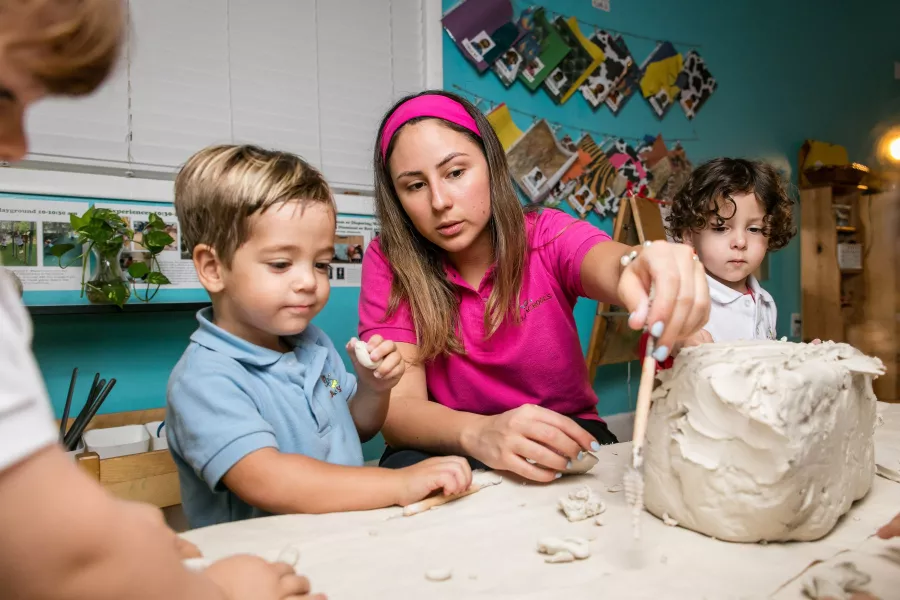
The Reggio Emilia philosophy views the environment as a third teacher. Classrooms are thoughtfully designed to invite exploration, dialogue, and expression. Open-ended materials, visual prompts, and accessible resources encourage children to communicate ideas in multiple ways, whether through words, movement, art, or construction.
This multi-modal approach supports diverse learners and reinforces the idea that language is not limited to spoken words. Children are empowered to express meaning using various forms of communication, strengthening overall language development.
In a Reggio Emilia–inspired preschool or childcare in West Palm Beach, language development is deeply embedded in relationships, inquiry, and meaningful experiences. By valuing children’s voices, encouraging exploration, and promoting collaboration, this approach supports communication skills that are foundational for lifelong learning. Language is not taught in isolation, it is lived, experienced, and co-constructed every day within a rich and responsive learning environment.