The Impact of Teacher
Executive Summary
The early years of a child’s life are critical for developing social, emotional, and cognitive skills. In alignment with the Reggio Emilia approach, we view the role of the teacher not just as an instructor but as a co-learner, guide, and collaborator. Positive relationships with teachers significantly impact a child’s well-being, school readiness, and future academic success. This white paper explores how nurturing teacher-child relationships can foster a child’s development, emphasizing the core beliefs of the Reggio Emilia philosophy.
The Role of the Teacher in the Reggio Emilia Approach
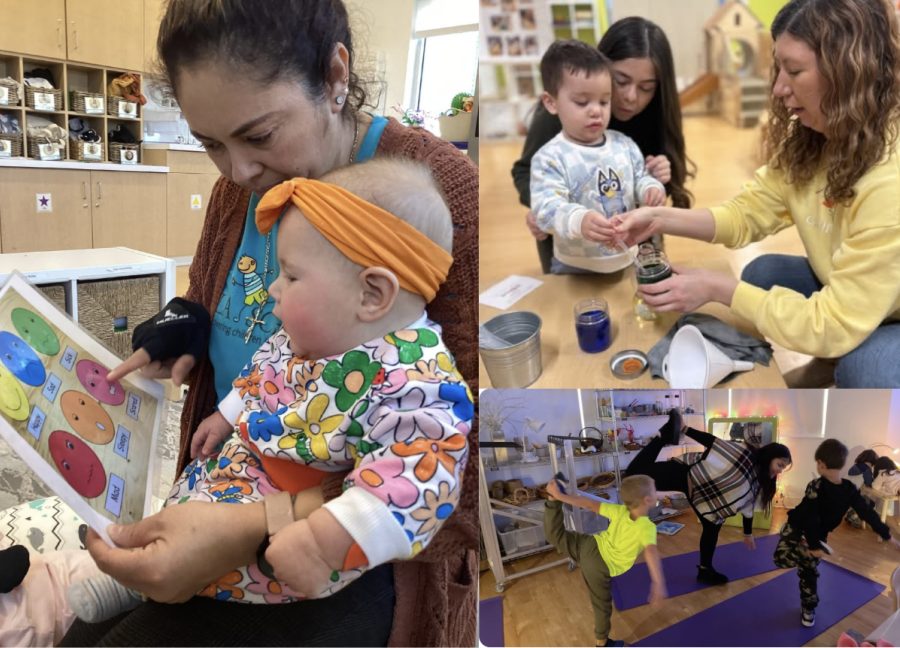
The teacher in the Reggio Emilia approach acts as a collaborator and facilitator, deeply engaged in observing, listening, and guiding children’s learning through meaningful relationships.
A Co-learner and Collaborator
Teachers engage in learning alongside children, valuing their ideas, thoughts, and theories.
A Guide and Observer
Teachers observe children’s interests and facilitate learning experiences based on those observations.
A Supportive Presence
Teachers create a safe, nurturing environment where children feel secure to explore and express themselves.
A Documenter
Teachers document children’s learning processes to reflect, understand, and plan future experiences.
This collaborative and respectful role reinforces trust, confidence, and a child’s sense of agency.
Why Are Strong Teacher-Child Relationships Important?
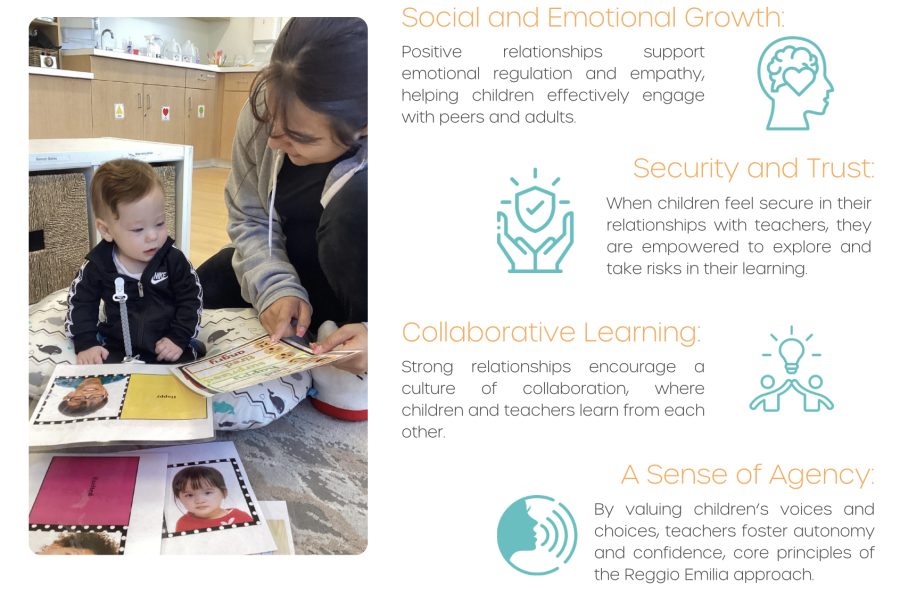
In line with the Reggio Emilia belief that relationships are fundamental to learning, strong teacher-child relationships provide:
Building Positive Teacher-Child Relationships the Reggio Emilia Way
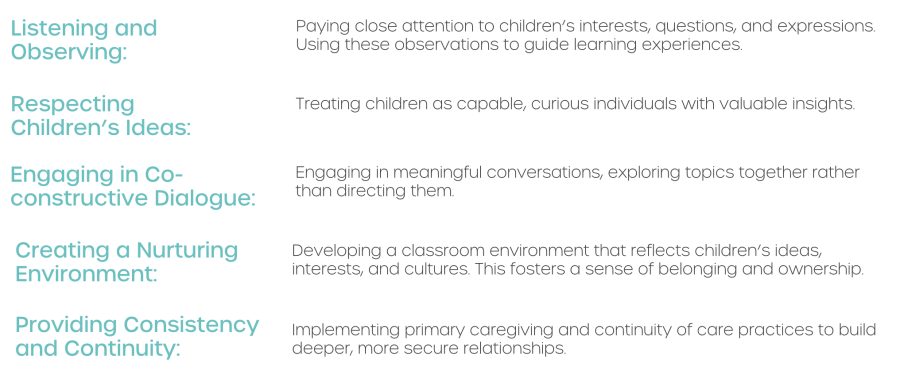
Teachers can build strong relationships by embodying Reggio Emilia principles in daily interactions by:
The Role of Parents in Supporting Teacher-Child Relationships
The Reggio Emilia approach emphasizes the importance of a strong partnership between teachers and parents. Parents can support these relationships by:
Sharing Insights:Sharing your child’s interests, routines, and family traditions with teachers.
Collaborating on Projects:Engaging in classroom activities or projects when possible.
Communicating Openly:Maintaining open lines of communication with teachers through regular meetings or informal check-ins.
Valuing the Child’s Voice:Reinforcing the idea that your child’s thoughts and ideas are important both at home and school.
The Impact on Children’s Development
When teachers adopt the Reggio Emilia approach and build positive relationships, children benefit by:
Becoming Lifelong Learners:Children develop a passion for learning through exploration and collaboration
Developing Resilience and Confidence:Supportive relationships help children handle challenges and setbacks constructively.
Enhancing Communication Skills: Children learn to articulate their thoughts and listen to others, fostering social competence.
The KLA Connection
We Are Co-Learners and Co-Discoverers
Our educators don’t simply teach — they learn with children. By observing children’s ideas and questions, teachers co-construct knowledge through meaningful dialogue and shared experiences. This mutual respect cultivates a sense of agency and confidence in every child.
We Observe, Listen, and Reflect
Every child’s journey is unique. Our teachers attentively observe children’s expressions, gestures, and emerging theories — using this insight to design intentional learning experiences that reflect their interests. These observations are documented to revisit, reflect, and deepen learning.
We Build Emotional Security Through Continuity
Our commitment to continuity of care ensures children form lasting, trusting relationships with familiar adults. Primary caregiving fosters emotional security, encouraging children to take intellectual and social risks with confidence.
We Bridge the Home-School Relationship
We believe that strong teacher-child relationships are most effective when supported by families. At KLA Schools, parents are viewed as essential partners in the learning journey. We invite parents to share insights, participate in classroom experiences, and celebrate their child’s growth.
We Invest in Our Teachers
The relationships we build with our educators mirror the care we expect them to bring to children. We hire individuals whose hearts beat in rhythm with children’s joy and curiosity. Through ongoing professional development, mentorship, and collaboration, our teachers grow into reflective, empowered practitioners.
In the Reggio Emilia approach, early childhood education's teacher-child relationship is a cornerstone. Teachers help children build a strong foundation for lifelong learning, confidence, and emotional well-being by serving as co-learners, guides, and collaborators. Positive, nurturing relationships not only shape a child’s current experiences but also influence their future success and happiness.
References:
My First Five Years. (n.d.). “How to Encourage Self-confidence and Self-awareness in Early Childhood.” Retrieved from: https://www.mffy.com/blog/self-confidence-and-self-awareness-in-early-childhood.
Gift Connect. (n.d.). “Brain Science and the Role of Parents & Caregivers in Early Childhood Development.” Retrieved from: https://gift-connect.org.
Edwards, C., Gandini, L., & Forman, G. (1998). The Hundred Languages of Children: The Reggio Emilia Approach to Early Childhood Education.